Why Stokes’ Theorem Is More Than a Formula
Stokes’ Theorem transcends mere mathematical formulae by elegantly connecting fundamental concepts of vector calculus through its three core applications: Gradient, Curl, and Divergence. This powerful theorem serves as a bridge between abstract mathematical relationships and tangible visualization, making complex concepts accessible to learners. The NablaVis project exemplifies this transformation by merging mathematics, visualization, and artificial intelligence into a cohesive educational experience. Rather than simply presenting equations, it renders abstract mathematical relationships into interactive, visual experiences that students can explore and understand.
This innovative approach represents a triple experimental framework: utilizing AI-assisted code generation (Google Gemini 3 with Antigravity), AI-assisted article writing (Claude Sonnet 4.5), and developing an interactive web application for mathematical learning. However, the human element remained paramount throughout – AI functioned as an amplifier of mathematical reasoning and design thinking rather than a replacement. Every component underwent rigorous manual review and validation, ensuring that human oversight guided the technological enhancement of mathematical understanding. This collaborative approach demonstrates how artificial intelligence can augment educational innovation while preserving the essential human judgment that transforms mathematical concepts into meaningful learning experiences.
Links
Article on Computational Mindset: https://computationalmindset.com/en/mathematics/nablavis-stokes-theorem.html
Working webapp: https://computationalmindset.com/apps/NablaVis
Source code on GitHub: https://github.com/ettoremessina/NablaVis
The code is distributed under MIT license; feel free to use, share, fork and adapt these materials as you see fit.
Also please feel free to submit pull-requests and bug-reports to this GitHub repository or contact me on my social media channels available on the contact page.
FAQ
What is NablaVis and what mathematical concepts does it visualize?
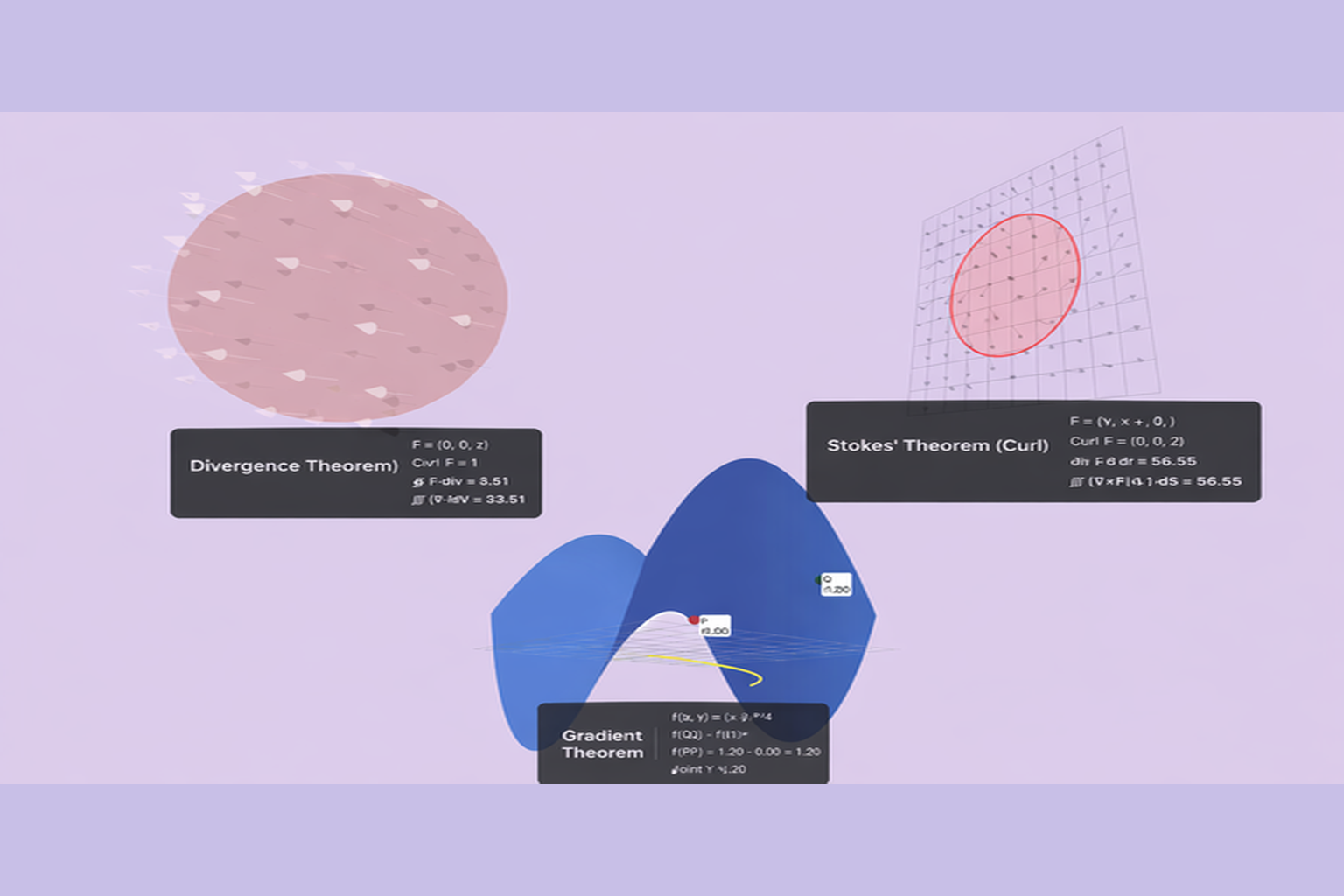
NablaVis is an interactive educational tool designed to help students understand Stokes’ Theorem and its three fundamental applications. The tool visualizes the Gradient Theorem (which deals with line integrals, conservative fields, and scalar potentials), Curl Theorem (covering circulation, flux, and rotational fields), and Divergence Theorem (showcasing flux through surfaces and source/sink strength). It provides intuitive 3D visualizations that make abstract mathematical concepts more accessible through hands-on exploration.
How does NablaVis help students understand the relationship between different vector calculus theorems?
NablaVis helps students understand the relationship between vector calculus theorems by providing side-by-side visualizations of how each theorem connects different mathematical concepts. Students can see how the Gradient Theorem relates line integrals to scalar potentials, how the Curl Theorem connects circulation to flux through surfaces, and how the Divergence Theorem links surface flux to volume sources or sinks. The tool allows users to manipulate fields and observe how these relationships hold across different scenarios, making the interconnected nature of vector calculus more apparent.
What technology stack powers NablaVis and how does it ensure smooth performance?
NablaVis is built using React for component-based architecture, Three.js for 3D rendering capabilities, and WebGL for hardware-accelerated graphics performance. The tool leverages TypeScript for type safety and Vite for fast development builds. The technical implementation includes sophisticated numerical algorithms to compute vector field properties in real-time, ensuring that users can interact with the visualizations smoothly while exploring mathematical concepts without performance lag.
What types of preset vector fields are available in NablaVis and how do they help learning?
NablaVis provides three distinct sets of preset fields organized by theorem type. For Gradient Theorem, users can explore Paraboloid, Saddle, and Gaussian Peak fields that demonstrate conservative vector fields. For Curl Theorem, Rotation, Shear, and Spiral fields illustrate circulation patterns and rotational behavior. For Divergence Theorem, Source, Sink, and Uniform fields show flux patterns and source/sink characteristics. These presets provide concrete examples that help students understand abstract concepts before experimenting with custom fields.
How does NablaVis support multilingual education and accessibility?
NablaVis includes comprehensive multilingual support that makes the educational tool accessible to students worldwide. The interface and educational content are available in multiple languages, allowing learners from different linguistic backgrounds to engage with the mathematical concepts. The tool’s interactive nature and visual approach also supports various learning styles, making complex vector calculus topics more accessible to students who might struggle with traditional text-based explanations.
What educational benefits does the interactive nature of NablaVis provide?
The interactive nature of NablaVis provides significant educational benefits by enabling hands-on exploration of mathematical concepts. Students can manipulate vector fields, adjust parameters in real-time, and immediately see how changes affect the relationships described by Stokes’ Theorem. This active learning approach helps solidify understanding through direct experimentation, provides real-time feedback on mathematical relationships, and allows students to develop intuition about abstract concepts that might otherwise seem disconnected from physical reality.
How does NablaVis implement the mathematical algorithms for its visualizations?
NablaVis implements mathematical algorithms through sophisticated numerical methods that calculate vector field properties in real-time. For each theorem application, the tool computes line integrals, curl operations, divergence calculations, and surface flux integrals using efficient numerical algorithms. The implementation includes proper handling of vector calculus operations such as gradient calculations, curl computations, and divergence analysis. These algorithms are optimized to run smoothly in the browser while maintaining mathematical accuracy for educational purposes.
What is the accessibility and availability of NablaVis for educational use?
NablaVis is completely free to access at computationalmindset.com/apps/NablaVis, making it widely available for educational institutions and individual learners. The tool is distributed under the permissive MIT license, allowing academic and commercial use without restrictions. Additionally, the source code is available on GitHub, enabling educators to customize the tool for specific educational needs or contribute improvements to the open-source community.
How does NablaVis support different learning levels and educational contexts?
NablaVis supports various learning levels through its layered approach to visualization. Beginners can start with the preset fields and guided exploration, while advanced users can create custom vector fields to test their understanding. The tool provides real-time feedback that helps students verify their mathematical reasoning and understand why certain theorems apply. It works well in both classroom settings where instructors can demonstrate concepts and individual learning environments where students can explore at their own pace.
What makes NablaVis unique compared to traditional vector calculus visualization tools?
NablaVis stands out by specifically focusing on the three applications of Stokes’ Theorem in an integrated, interactive environment. Unlike tools that visualize individual vector calculus concepts in isolation, NablaVis connects these concepts through the unified framework of Stokes’ Theorem. Its combination of React-based interactivity with Three.js 3D rendering provides a more immersive learning experience than traditional 2D visualizations. Additionally, its educational focus with multilingual support and free access makes it particularly valuable for global educational outreach.